Some days, it’s not that you can’t do things.
It’s that everything takes more out of you than it should.
More effort.
More energy.
More recovery afterwards.
This is where Spoon Theory can really help make sense of things.
A simple way to understand energy
Spoon Theory was created by Christine Miserandino to explain what it feels like to live with limited energy.
Imagine your energy as a small number of spoons.
Each thing you do during the day uses one:
- Getting out of bed
- Getting dressed
- Talking to someone
- Going to school or work
And when the spoons are gone… they’re gone.
There’s no pushing through without a cost.
A simple way to use the “12 spoons”
Sometimes it helps to make this very concrete.
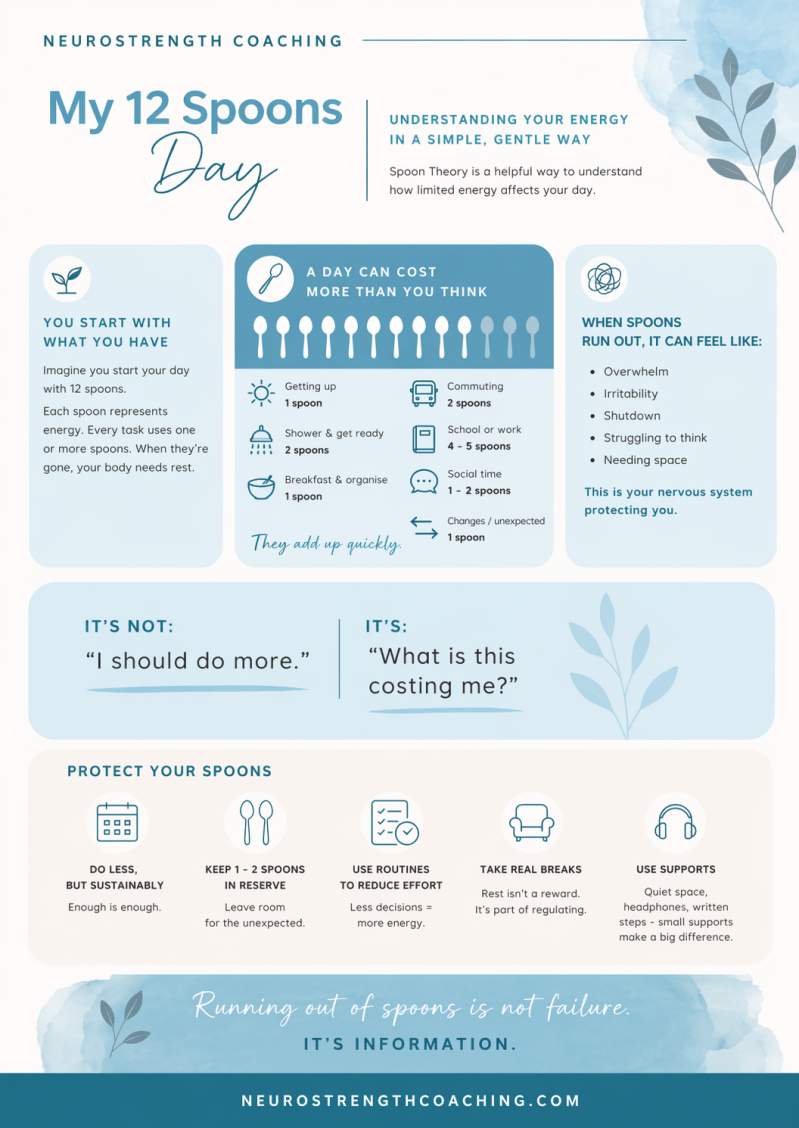
Imagine you start your day with 12 spoons.
Not everyone has 12.
Some days you might have 8.
Some days maybe 15.
But let’s take 12 as a simple example.
What a day can actually cost
A day might look something like this:
- Getting out of bed → 1 spoon
- Showering and getting dressed → 2 spoons
- Breakfast + organising yourself → 1 spoon
- Commuting → 2 spoons
- School or work → 4–5 spoons
- Social interaction → 1–2 spoons
- Transitions or small unexpected changes → 1 spoon
And just like that, your spoons are gone.
Even before anything extra is added.
Why this matters
If your day already uses all your spoons…
There is nothing left for:
- homework
- conversations
- errands
- flexibility
- coping with stress
So when someone says
“just one more thing”
it may actually cost a spoon you don’t have.
Why this matters in autism
For many autistic adolescents and adults, everyday life isn’t actually “simple.”
Things that look small on the outside can be quite demanding on the inside.
Getting dressed might involve:
- Sensory discomfort
- Too many choices
- Needing things to feel “right”
A school or work day might involve:
- Noise, lights, movement
- Constant social processing
- Managing expectations
- Holding everything together
All of this uses energy.
Often a lot more than people realise.
When the spoons run out
When energy is low or gone, the nervous system starts to protect.
This can look like:
- Feeling overwhelmed very quickly
- Irritability or emotional spikes
- Struggling to think or find words
- Needing to withdraw or escape
Sometimes this leads to meltdowns or shutdowns.
Not as a behaviour problem.
But as a capacity problem.
When it keeps happening: burnout
If someone keeps using more energy than they have, day after day, something deeper can happen.
Autistic burnout.
This isn’t just being tired.
It can look like:
- Deep exhaustion
- Reduced tolerance to sensory input
- Loss of skills or capacity
- Pulling back from daily life
It often happens quietly.
And it often happens after a long time of coping.
What quietly uses up energy
Not all effort is visible.
Some of the biggest “spoon users” are things people don’t see:
- Sensory input (noise, light, textures)
- Social interaction and masking
- Decision-making
- Transitions
- Anxiety and internal pressure
These add up across the day.
Even if everything looks “fine” from the outside.
Protecting your energy (without pushing harder)
This is the important part.
It’s not about trying to do more.
It’s about being a bit more intentional with what you have.
Some gentle ways to start:
Reduce what you can
Not everything needs to be done.
Sometimes “enough” is enough.
Plan in spoons, not just tasks
Instead of a long to-do list, ask:
How much will this cost me today?
Keep 1–2 spoons in reserve
If possible, don’t use everything.
This helps with the unexpected.
Balance your day
One bigger task.
A few smaller ones.
Then rest.
Make things more predictable
Routines reduce effort.
Less decision-making = fewer spoons used.
Use supports
Headphones, breaks, written steps, flexible pacing.
Small supports can make a big difference.
Say what you need (when you can)
“I need a quieter space.”
“I need more time.”
These aren’t big asks.
They’re ways of protecting energy.
Why this way of thinking helps
Spoon Theory gives language to something many people feel but struggle to explain.
“I’m out of spoons”
simply means
“I’ve reached my limit.”
It shifts things from:
- “Why can’t you just do it?”
to:
- “What is this costing you?”
And that changes everything.
🌿 A final thought
Energy isn’t unlimited.
For many autistic people, it needs to be:
- noticed
- respected
- protected
When we understand that,
we stop asking for more effort…
and start offering the right support.