Why Social Situations Can Feel So Confusing for Autistic Teenagers
Most social rules are never actually taught.
They are simply expected.
People somehow “just know” when to speak, how long to talk for, how loudly to laugh, when a joke is serious, when someone is annoyed, or when a conversation is ending.
For many autistic teenagers, these rules can feel invisible.
And when everybody else seems to understand them automatically, social situations can quickly become exhausting, confusing, or overwhelming.
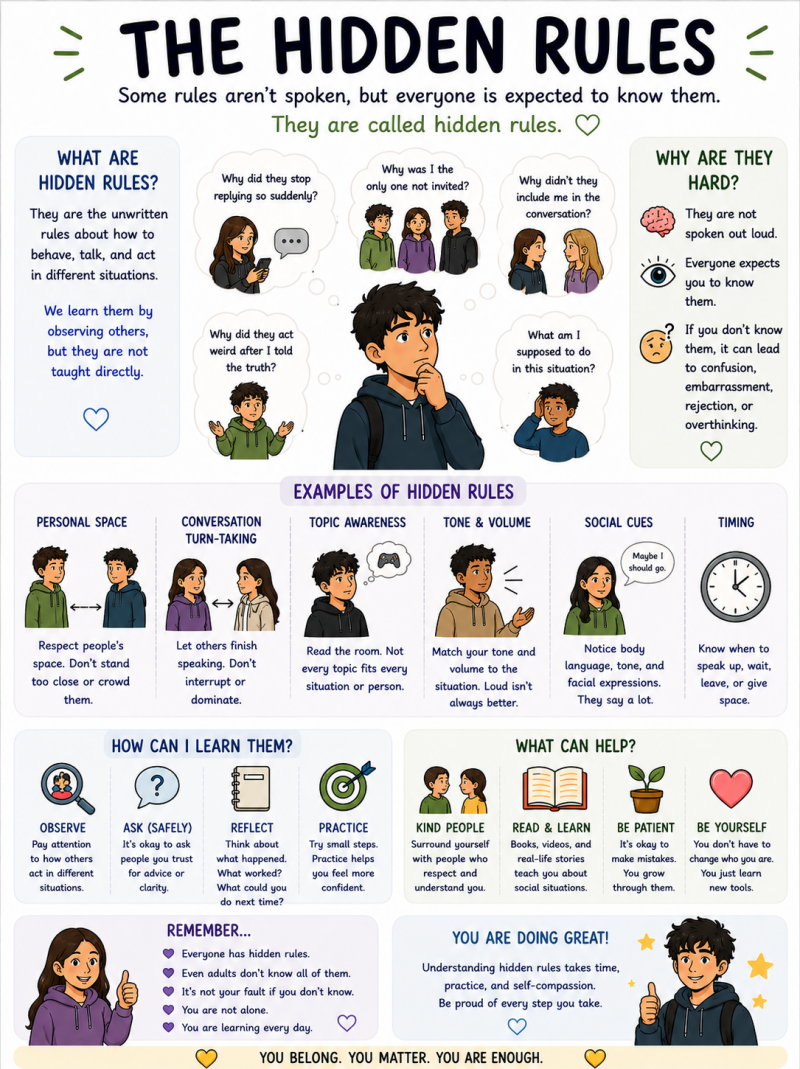
What Are “Hidden Rules”?
Hidden rules are the unwritten expectations that exist in everyday life.
They appear in:
- friendships
- classrooms
- group chats
- family conversations
- sports teams
- dating
- social media
- school corridors
Nobody usually explains these rules directly.
People learn them by observing others over time.
Examples include:
- knowing when it is your turn to speak
- understanding sarcasm or hints
- recognising when someone wants space
- changing tone depending on the situation
- knowing which topics are “okay” in different settings
- noticing facial expressions or body language
- understanding how long to stay in conversations
For autistic teenagers, these expectations are not always obvious or intuitive — especially when anxiety, sensory overload, masking, or slower processing are involved.
Why Hidden Rules Can Feel So Stressful
Many autistic teenagers spend huge amounts of energy trying to “work out” social situations.
This can lead to:
- overthinking conversations afterwards
- replaying interactions repeatedly
- feeling rejected or left out
- shutdowns after social situations
- masking to avoid getting things wrong
- exhaustion from constantly analysing people
Sometimes adults misinterpret this as:
- “being too sensitive”
- “overreacting”
- “not trying”
- “being rude”
But often, the nervous system is simply trying to understand an unpredictable social environment.
Strategies That Can Help
1. Make Hidden Rules Visible
Do not assume teenagers automatically understand social expectations.
Explain things directly and clearly:
- “People usually take turns talking here.”
- “When someone gives short answers, they may want space.”
- “Group chats often move quickly — it’s okay if you don’t reply immediately.”
- “Sometimes people say ‘maybe’ when they actually mean no.”
Clear explanations reduce anxiety and confusion.
2. Use Social Debriefs Instead of Criticism
After difficult situations, avoid:
- “Why would you say that?”
- “You embarrassed yourself.”
- “You should know better.”
Instead, try:
- “What do you think happened there?”
- “Was there a part that felt confusing?”
- “Would it help if we broke that situation down together?”
Teenagers learn social understanding more easily when they feel safe rather than ashamed.
3. Teach Pattern Recognition
Many autistic teenagers benefit from learning social situations as patterns rather than vague instincts.
For example:
- If someone keeps looking at the door → they may want to leave.
- If a group becomes quiet suddenly → the topic may have changed.
- If someone steps backwards → they may need more personal space.
Learning patterns can make social situations feel more predictable and manageable.
4. Reduce Social Overload
Social processing takes energy.
A teenager may cope well for a short time and then suddenly crash afterwards.
Build in:
- recovery time after school
- breaks from group settings
- quiet spaces
- low-demand evenings after social events
- permission to leave overwhelming situations
Supporting regulation helps social understanding far more than pressure does.
5. Practise Scripts for Difficult Situations
Having prepared phrases can reduce anxiety significantly.
Examples:
- “Can you explain what you mean?”
- “I need a minute to think.”
- “I’m not sure what to say right now.”
- “I’m going to take a break.”
- “Was that a joke or serious?”
Scripts are not “fake.”
They are supportive tools that reduce cognitive load during stressful moments.
6. Focus on Safe People
Not every environment is supportive.
Not every friendship is healthy.
Teenagers often cope better socially when they are around people who:
- communicate clearly
- respect boundaries
- do not mock differences
- allow processing time
- feel emotionally safe
The goal is not to fit in everywhere.
It is to build connections where a teenager can feel understood and accepted.
7. Remember That Social Skills Are Two-Way
Autistic teenagers are often expected to do all the adapting.
But healthy communication should work both ways.
Adults, peers, teachers, and families can also help by:
- being clearer
- reducing sarcasm
- saying what they mean
- avoiding vague expectations
- giving processing time
- checking understanding without judgement
Support should not mean teaching someone to hide who they are.
A Different Perspective
Autistic teenagers do not need to become different people to belong.
Often, they simply need:
- clearer communication
- safer environments
- more explicit expectations
- understanding instead of judgement
Because many social difficulties are not caused by “lack of effort.”
They come from trying to navigate rules that were never explained in the first place.
And once those rules become visible, everything can start to make more sense.