

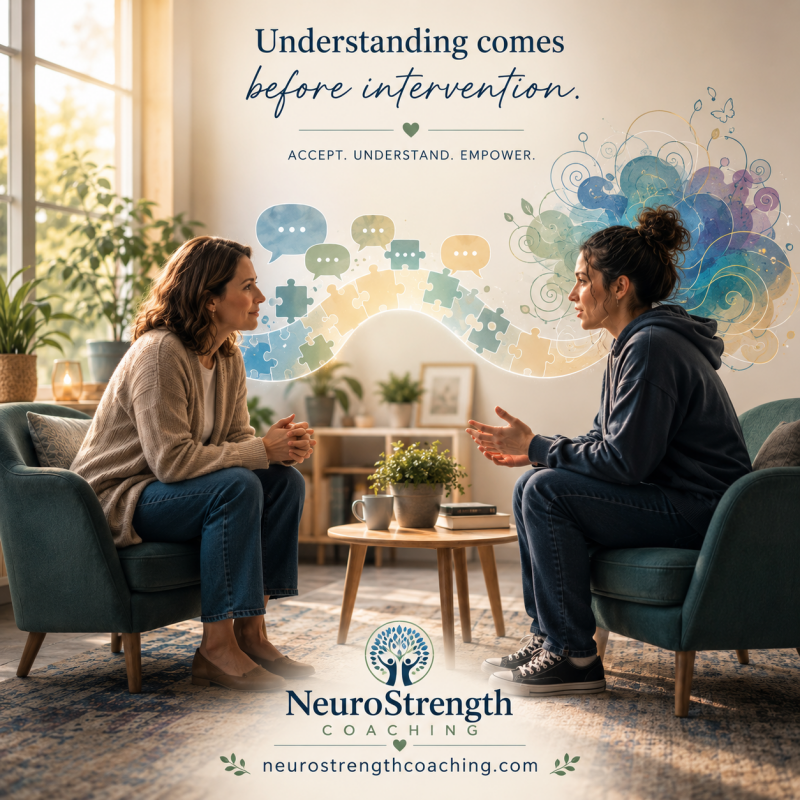
One of the biggest misconceptions I hear from professionals is this:
"If I validate my client's experience, aren't I agreeing with everything they're saying?"
It's an understandable concern.
As therapists, coaches, teachers, and healthcare professionals, we want to be compassionate while also helping people grow. We worry that validation might reinforce unhelpful behaviours or prevent change.
This is where Dialectical Behaviour Therapy (DBT) offers one of its most valuable lessons.
Validation is not the same as agreement.
Understanding this distinction can transform the way we work with autistic clients.
What Is Validation?
Validation means communicating that another person's thoughts, feelings, or experiences make sense within the context of their life.
It is an attempt to understand the person's internal world rather than judge it.
Validation does not mean saying:
"You're right."
It means saying:
"Given what you've experienced, I can understand why you feel that way."
Those are two very different messages.
Why This Matters for Autistic Clients
Many autistic people grow up hearing messages such as:
"You're too sensitive."
"You're overreacting."
"Everyone else can cope."
"Just ignore it."
"You need to be more flexible."
Although these comments are often well intentioned, they can leave people feeling misunderstood and doubting their own experiences.
Imagine an autistic teenager who becomes overwhelmed in a noisy classroom.
If we respond by saying,
"It's not that loud."
we are responding to our experience of the environment.
If instead we say,
"It sounds as though the noise felt overwhelming for you,"
we acknowledge their experience.
That doesn't mean we agree that every classroom is unbearably noisy.
It means we recognise that, for this individual, the experience was real.
That simple shift builds trust.
Validation Creates Safety
One of the most important lessons from DBT is that people are far more open to learning when they feel understood.
When clients feel invalidated, they often become defensive, withdraw from therapy, or feel they need to justify themselves.
When they feel validated, something different happens.
Their nervous system begins to settle.
They no longer have to fight to convince someone that their experience is real.
Only then can they begin exploring solutions.
Validation is not the end of therapy.
It is the beginning of effective therapy.
Validation and Change Can Exist Together
This is where DBT introduces its dialectical philosophy.
Two things can be true at the same time.
You can validate a client's experience and help them develop new skills.
For example:
"I completely understand why you left the shopping centre when it became overwhelming."
And...
"Let's explore some strategies that might help you recognise the early signs of overload next time."
The first statement communicates acceptance.
The second supports growth.
Neither cancels out the other.
An Autism-Affirming Approach
As autism-affirming professionals, our goal is not to change autistic identity.
Our goal is to reduce distress, improve quality of life, and help clients develop strategies that work for them.
That starts by recognising that behaviours often have a purpose.
A person may stim because it helps regulate their nervous system.
They may avoid eye contact because it reduces cognitive load.
They may leave a busy environment because their sensory system is overwhelmed.
Before asking how to change a behaviour, we should first ask:
"What need is this behaviour meeting?"
That question shifts us from judgement to curiosity.
And curiosity is where meaningful therapeutic relationships begin.
Final Thoughts
Validation is not about agreeing with every thought, behaviour, or decision.
It is about recognising another person's experience as real and worthy of understanding.
For autistic clients, who have often spent years feeling misunderstood, that can be one of the most powerful therapeutic interventions we offer.
Before we teach skills...
Before we challenge beliefs...
Before we encourage change...
We need to help people feel understood.
Because understanding isn't separate from therapy.
It is where therapy begins.